
H₂AS-S1 / in development
Persistent hydrogen-powered aerial surveillance
Hours on station, low acoustic and thermal signature, and track data that plugs into your existing security and counter-UAS systems.
Development objectives, not demonstrated capabilities. Endurance, acoustic and thermal performance, detection, tracking and interoperability require configuration-specific validation.
01 / The challenge
Look beyond the ground horizon.
Low-flying fixed-wing drones and loitering munitions are hard to detect from the ground. They fly below radar horizons, behind terrain, and often emit no radio signal. Perimeter cameras and ground sensors see them late.
02 / The H₂AS-S1 approach
Airborne awareness. Human control.
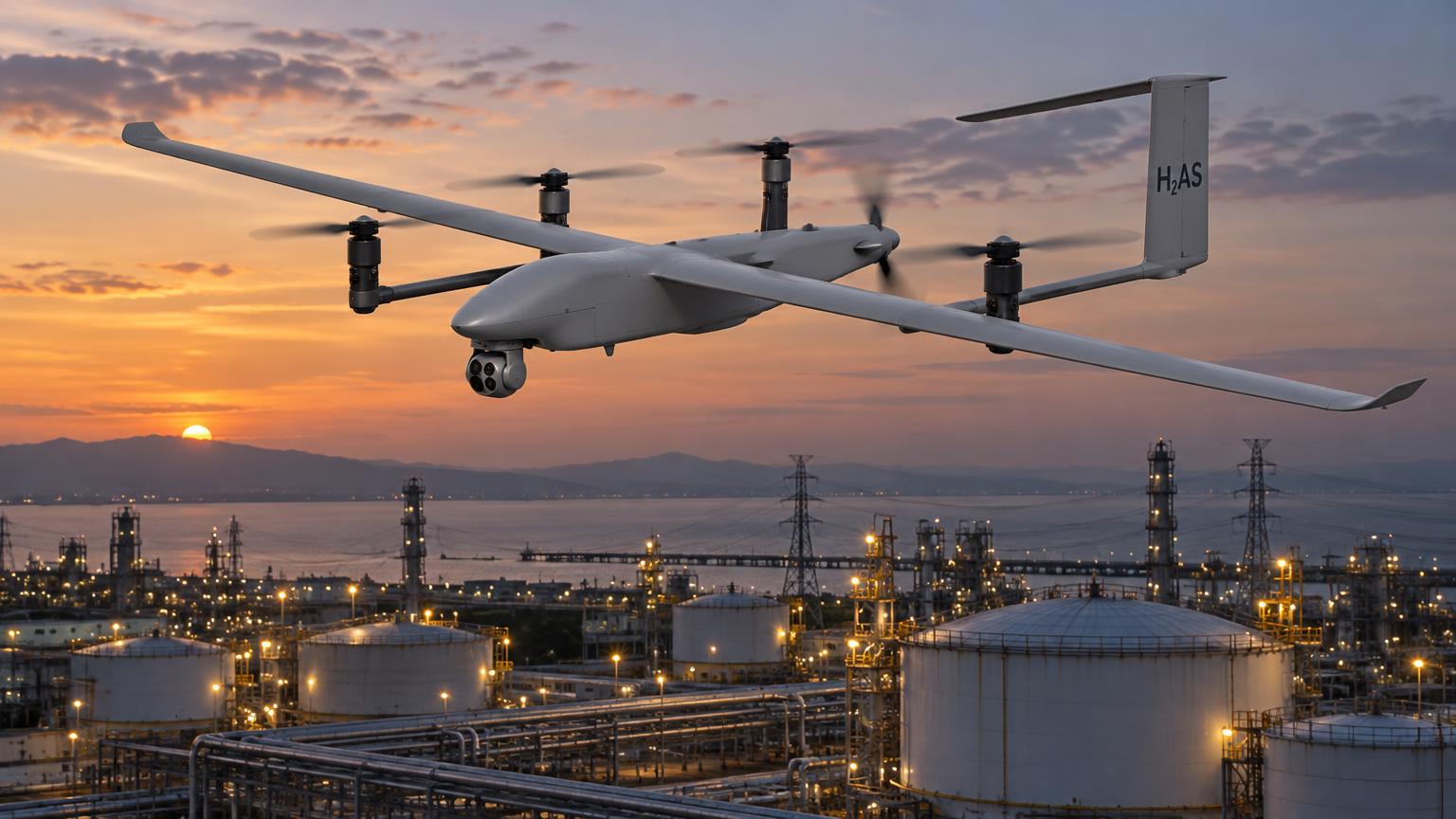
The H₂AS-S1 is a hydrogen fuel-cell fixed-wing VTOL surveillance drone in development. Flying high above the protected area, it extends detection range beyond the ground horizon, tracks targets with EO/IR sensors and onboard AI, and passes track data to the site's command-and-control system. A human operator stays in control of every response decision.
This describes the intended architecture. No validated detection performance, customer deployment or completed C2 integration is claimed.
03 / How it works
From detection to operator decision.
01
Detect
Persistent airborne EO/IR coverage over the approaches
02
Track
Onboard AI classifies and geolocates targets
03
Share
Tracks sent to site C2 and counter-UAS systems in standard formats
04
Respond
The operator decides; integrated defenses are cued early
04 / Why hydrogen
Energy for sustained coverage.
- Hours of endurance per sortie, versus minutes for battery drones
- Low noise and heat signature; zero combustion emissions
- Fast cylinder swap for continuous coverage with a small fleet
These are application-specific design objectives, not universal comparisons with battery aircraft. Actual endurance and signatures depend on the complete aircraft and duty cycle. Cylinder-swap turnaround requires safe handling and suitable hydrogen logistics. Fuel-cell operation has no combustion emissions; lifecycle emissions depend on hydrogen production and supply.
05 / Development targets
H₂AS-S1 target specifications (in development)
- Configuration
- Fixed-wing VTOL, no runway required
- Endurance
- 8–10 hours (target)
- Mission payload
- EO/IR gimbal with laser rangefinder and edge AI (target 3.5 kg)
- Power
- Hydrogen PEM fuel cell with hybrid battery
- Data outputs
- Standard track and video formats for C2 integration
- Turnaround
- Rapid hydrogen cylinder swap
All performance figures are preliminary targets for a system in development and are not guarantees of achieved performance.
06 / Applications
Persistent awareness for critical sites.
- Oil, gas and power sites
- Airports
- Pipelines and linear infrastructure
- Ports and coastal facilities
- Border and perimeter security
Potential applications only. Airspace permissions, site safety, sensing requirements and system interfaces must be assessed for each program.